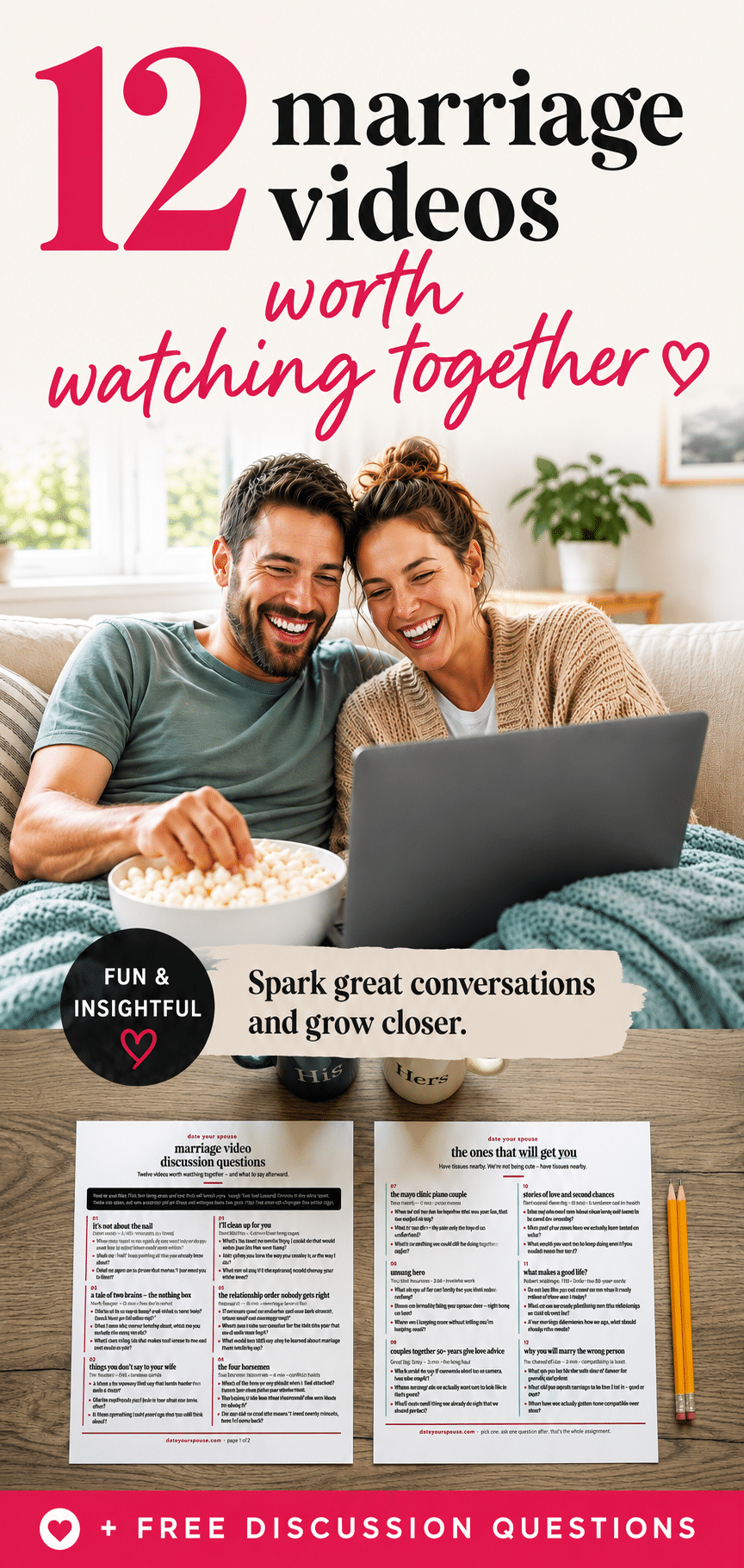
We have taught a lot of marriage classes over the years. Church groups, couples retreats, tense rooms where reluctant spouses stared at the floor, and breakthrough moments where a woman in the back row cried.
Here is what we learned: nobody remembers the outline.
They remember the videos.
Two minutes of a comedian saying the exact thing you said in the car last Tuesday can do more for a marriage than forty minutes of very good advice. Something about laughing at yourself first makes the truth go down easier. And a video does something a lecture cannot — it lets you both look at the screen instead of at each other while a hard thing gets named out loud.
So we finally rounded them up. Twelve marriage videos, most of them under five minutes, each one with a short explanation of what it actually teaches and two or three questions to talk about afterward.

Watch them on a date night, use them in a class, or just send one to your spouse at 2pm with no explanation.
What Are the Best Marriage Videos to Watch Together?
The best marriage videos to watch together are short clips — usually two to five minutes — that name one specific pattern in a marriage and make you laugh or tear up before you can get defensive about it. The classics that show up in almost every marriage class are It’s Not About the Nail (listening versus fixing), Mark Gungor’s Tale of Two Brains (how differently husbands and wives process), Tim Hawkins’ Things You Don’t Say to Your Wife (careless words), and Bruno Bozzetto’s wordless Women vs Men animation (how differently husbands and wives approach intimacy).
A video only works, though, if you talk about it after. Otherwise you have just watched YouTube next to each other, which — and we say this with love — you already do.
That is why every video below comes with questions.
How to Turn This Into a Date Night
You do not need to watch all twelve.
Here is the format that works, and it takes about twenty-five minutes:
- Pick two funny ones and one that will wreck you. Laugh first, feel second. Doing it in the other order is emotional whiplash.
- Put the phones in the other room. Cast it to the TV if you can.
- After each video, ask one question. Just one. The questions are below, and there is a printable sheet further down if you would rather not scroll on your phone mid-date.
- Whoever talks less goes first. This one rule changes the whole night.
- Add dessert. Our at-home Pizookie takes fifteen minutes and makes anything feel like an occasion.
If tonight is more of a we just want to laugh night, skip all of this and go do our YouTube scavenger hunt date instead — same platform, but playing instead of learning.
The Funny Ones (Start Here)
Every one of these is clean, and every one of them is somebody’s marriage. Probably yours.
1. It’s Not About the Nail
1:41 · Best for: the spouse who fixes when they should be listening
A woman sits on a couch describing a relentless pressure in her head. There is a nail in her forehead. Her husband points this out. She does not want him to point this out.
Jason Headley made this in 2013 and it has been shown in marriage classes ever since, because it captures something almost impossible to explain in a fight: being heard and being helped are two different needs, and offering the second one when your spouse asked for the first lands as dismissal.
The part people miss is the ending. He stops solving, repeats her feelings back to her, and she softens instantly. It costs him nine seconds. He was right about the nail the whole time — it just was not the point yet.
Talk about it:
- When you come to me upset, do you usually want help or do you want me to listen? How would I know which one?
- What is a “nail” I keep pointing at that you already know about?
- Could we agree on a phrase — something like “I just need you to listen” — so we stop guessing?
2. A Tale of Two Brains — The Nothing Box
About 5 minutes · Best for: the wife who cannot believe he is thinking about nothing
Mark Gungor’s bit is that a man’s brain is made of boxes that do not touch — money box, kid box, car box — and he opens one at a time. A woman’s brain is a ball of wire where everything connects to everything and it is all powered by emotion.
Then he gets to the nothing box. Men have a box with nothing in it, and given the chance, they will go there.
To be clear, this is a comedy routine and not neuroscience — real brains do not come in boxes, and plenty of couples find the roles reversed at their house. Take it as a metaphor, not a diagnosis.
But the reason it has been shown in ten thousand church basements is that it defuses a fight a lot of couples have been having for years. “What are you thinking about?” “Nothing.” “That’s not an answer.” — turns out it was an answer.
If you want the full seminar, it is available directly from Mark Gungor’s site.
Talk about it:
- Which of us is more “boxes” and which of us is more “wire”? Does it ever go the other way?
- When I ask what you’re thinking about, what are you actually hearing me ask?
- What is one thing I do that makes total sense to me and zero sense to you?
3. Things You Don’t Say to Your Wife
2:11 · Best for: openers, icebreakers, and husbands who need a warning
Tim Hawkins sings a very tender love song made entirely of sentences that will get a man in trouble. “Are you gonna eat all that?” “Is that what you’re wearing?” It is a rock ballad and it is devastating.
The reason it earns a spot in a marriage class instead of just a comedy special is the mechanism underneath the joke: almost none of these sentences were meant to wound. They are throwaway lines. They cost the speaker nothing and they stay with the listener for a decade.
It is a very easy video to watch together and a slightly harder one to discuss honestly, which is exactly why it is worth it.
Talk about it:
- Is there a throwaway line I say that lands harder than I think it does?
- What is a sentence you would love to hear from me more often?
- Is there something I said years ago that you still think about?
4. I’ll Clean Up For You
A few minutes · Best for: tired parents who think romance requires a reservation
Another Tim Hawkins love song, except this one is about doing the dishes.
The joke is that the romantic gesture his wife actually wants is not a candlelit anything. It is somebody else handling the kitchen. And underneath the joke is the single most useful idea in marriage advice: the thing that makes your spouse feel loved is often not the thing that would make you feel loved.
This is the love languages conversation, delivered by a man with a guitar in about four minutes. If it lands, our date ideas for every love language is the natural next step.
Talk about it:
- What is the least romantic thing I could do that would actually make you feel the most loved?
- Am I giving you love the way you receive it, or the way I do?
- What is one chore that, if it just disappeared, would change your whole week?
5. Women vs Men — Start at 3:09
Start at 3:09 · Best for: the biggest laugh we have ever gotten in a marriage class
In most marriages, husbands and wives view intimacy pretttty differently. This little animation shows the difference better than any book we have ever handed anyone.
Here is all you need to know before you press play. The peach circle is the woman. The blue square is the man. Start it at 3:09. First you will see her approach. Then you will see his.
There is no dialogue — it is a wordless short by Italian animator Bruno Bozzetto — so nothing gets lost and nothing gets awkward. Just two shapes going about the same evening completely differently while everyone in the room slowly realizes they are watching their own marriage.
It is exaggerated on purpose, and half the fun is arguing afterward about who is the circle and who is the square. It is not always the one you would expect.
Talk about it:
- Which one of us was the circle and which one was the square? Did we both give the same answer?
- What does the runway to a good night actually look like for you? Be specific — this is the whole point of the video.
- What is one small thing I could do earlier in the day that would matter more than anything I do at 10pm?
6. The Mouth Guard Scene from Date Night
A short one minute clip · Best for: anyone who owns a retainer, a CPAP, or a heating pad
Steve Carell and Tina Fey are married, exhausted, and getting into bed. One of them makes a move. The other one has already put in the mouth guard.
Every couple who has been married more than about four years laughs at this one immediately, and a little too loudly, because it is not really a joke about a mouth guard. It is a joke about how the ordinary machinery of a shared life — the retainer, the laundry pile, the alarm set for 5:40 — quietly crowds out the part of marriage you actually got married for.
Nobody decides to stop. It just erodes, one very reasonable Tuesday night at a time. That is worth naming out loud, and it is exactly the drift we wrote about in roommate syndrome in marriage.
Talk about it:
- What is our version of the mouth guard — the ordinary thing that quietly ends the evening?
- When did we last get into bed at the same time, awake, without a screen?
- If we protected one night a week from the routine, which night could it realistically be?
The Ones That Will Get You
Have tissues nearby. We are not being cute — have tissues nearby.
7. The Mayo Clinic Piano Couple
1:15 · Best for: remembering that marriage is supposed to be fun
Marlow and Frances Cowan are in the lobby of the Mayo Clinic. He is there because of a heart condition. There is a piano.
They sit down and play a duet they have been playing together for six decades, elbows bumping, both of them grinning like teenagers, and at the end he does a little flourish and she laughs at him the way you laugh at someone whose bits you have heard nine hundred times.
Sixty-two years of marriage and they are still doing bits for each other. That is the whole lesson. Not the piano — the playfulness. Play is the thing most couples quietly stop doing first, and it is the easiest one to start again.
Talk about it:
- What did we used to do together that was pure fun, that we stopped doing?
- What is “our bit” — the joke only the two of us understand?
- What is something we could still be doing together at eighty?
8. Unsung Hero
3:04 · Best for: the spouse who does everything and says nothing
A Thai insurance ad, of all things, and it has close to forty million views for a reason.
A man does small unnoticed kindnesses every day. He gets nothing back — no thank-you, no recognition, no promotion. The question the ad asks is what he is actually receiving, and the answer is not what you expect.
We use it in marriage settings because it reframes the most common resentment in a household: the sense that you are the only one doing the invisible work. Sometimes that resentment is legitimate and needs to be said out loud. And sometimes both people are quietly doing invisible work for each other and neither has noticed the other’s.
Talk about it:
- What do you do for our family that you think nobody notices?
- Name one invisible thing your spouse does — right now, out loud.
- Where am I keeping score without telling you I’m keeping score?
9. He Still Treats Her Like a Princess
4 minutes · Best for: the moment you remember what you actually promised
An elderly husband cares for a wife who can no longer care for him back. She cannot return the favors. She cannot split the chores. Most days she cannot say thank you.
He serves her like a princess anyway.
Watch this one and then try to hold onto whatever you were keeping score about. Most of what we call love is actually an exchange — I do this, you do that, we stay roughly even. This is the other thing. The thing the vows were pointing at the whole time, that almost nobody thinks about on their wedding day because it sounds so far off.
Every couple watching is one bad phone call away from being in this video.
Talk about it:
- What do you need me to know about how you would want to be cared for someday?
- What part of our vows have we actually been tested on so far?
- What would you want me to keep doing even if you could never thank me for it?
10. The Story of Sarah & Juan
3:38 · Best for: proof that the small stuff is the big stuff
Yes, it is a gum commercial. Watch it anyway.
A boy and a girl meet in high school. Over the years he keeps handing her a stick of gum — walking home, first apartment, the airport, the fight. What she does not know is that he has been folding every wrapper into a little origami drawing of that moment and keeping them.
The whole idea is right there in their tagline: give extra, get extra. The tiny thing you hand your spouse on a Tuesday is not tiny. It is a deposit. And when you line up ten years of deposits at once, it turns out you built something.
Almost nobody in your life is keeping the wrappers. Your spouse is. If you want a structured way to start making those deposits, the monthly anniversary tradition that kept one woman feeling cherished for 66 years is the same principle with a start date.
Talk about it:
- What is the small thing I do that you would actually miss if I stopped?
- What moment from our first year together do you still think about?
- What is one deposit I could make every single day this week without you having to ask?
11. What Makes a Good Life? (The 85-Year Harvard Study)
12:46 · Best for: the spouse who needs data, not feelings
Robert Waldinger directs the longest study of adult life ever conducted — Harvard has been tracking the same men, and later their families, since 1938.
The finding, after eight decades: the quality of your close relationships at fifty predicts your health at eighty better than your cholesterol does. Not wealth. Not fame. Not career. The people who were most satisfied in their relationships were the healthiest and the happiest, and loneliness was as damaging as smoking.
He also notes something worth sitting with — the couples who did best were not the ones who never fought. They were the ones who knew they could count on each other when it mattered.
Show this one to the spouse who thinks working on the marriage is a soft, optional, feelings-based activity. It is a health intervention with a very long dataset.
Talk about it:
- Do you feel like you can count on me when it really matters? Where am I shaky?
- What are we currently prioritizing over this relationship — and is it worth it?
- If our marriage is the thing that determines how we age, what should change this month?
12. Why You Will Marry the Wrong Person
22:20 · Best for: the best argument you will have all year
Provocative title, and we are including it on purpose.
The argument is not that you chose badly. It is that every person is difficult to live with in ways they cannot see, including you — and that the romantic idea of finding someone with whom there is no friction sets couples up to interpret normal marriage as evidence of a mistake.
The healthier version, the video argues, is compatibility as an achievement rather than a precondition. Something you build over years, not something you screen for.
It comes from a secular philosophy channel, so the framing is not faith-based — but the core idea sits comfortably next to a covenant view of marriage, and it starts better conversations than almost anything else on this list.
Talk about it:
- What are you hard to live with about? Answer for yourself, not for me.
- What did you expect marriage to be that it isn’t — good or bad?
- Where have we actually gotten more compatible over time?
Videos for a Marriage Retreat, Class, or Small Group
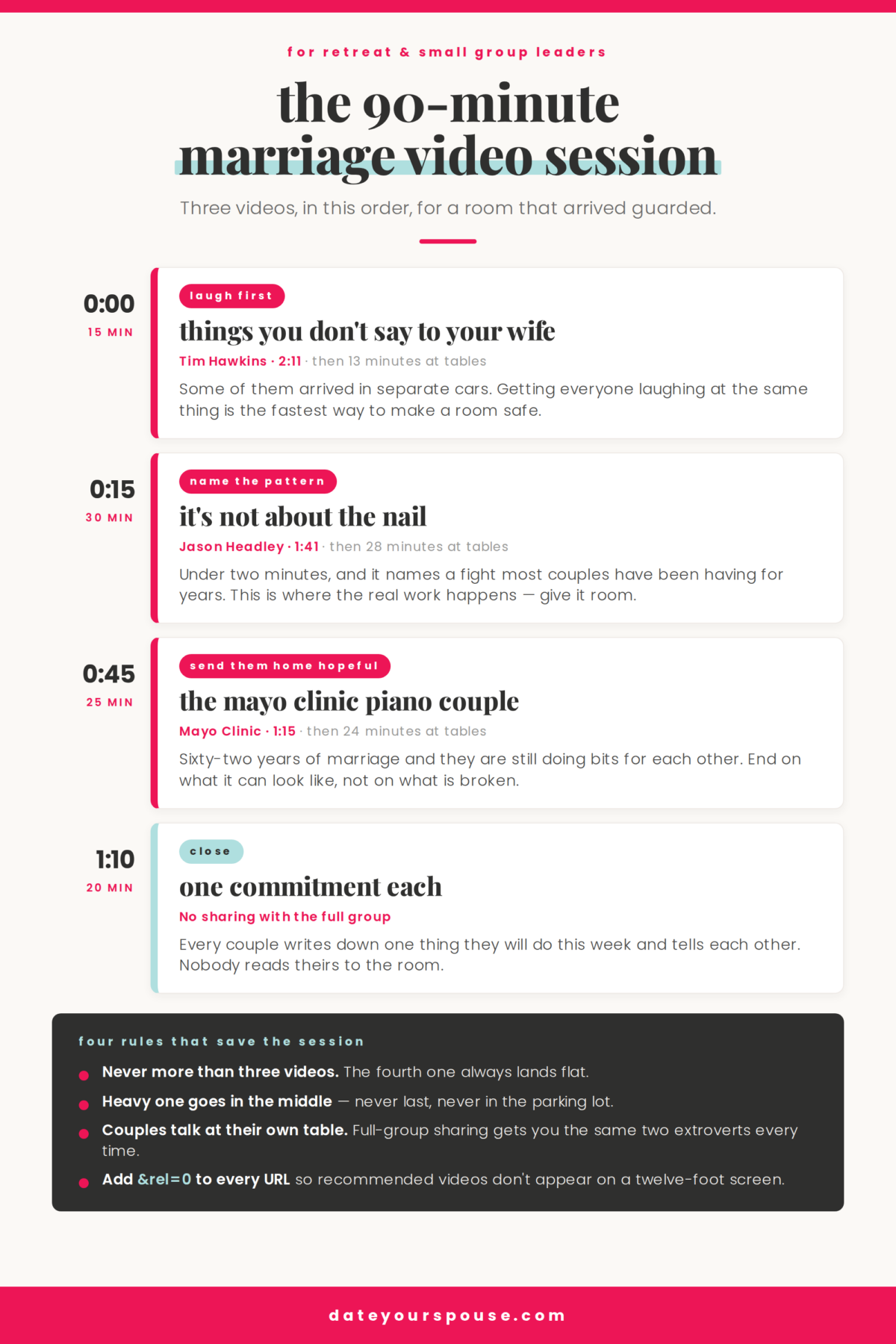
If you are the one standing at the front of the room, a few things we have learned the hard way.
Open funny. Always. A room of couples arrives guarded — some of them arrived in separate cars. Things You Don’t Say to Your Wife or the Nothing Box gets everyone laughing at the same thing, which is the fastest way to make a room safe.
Put the heavy one third, not last. If you end on Unsung Hero and immediately dismiss everyone to the parking lot, you have handed people a lot of feeling and nowhere to put it. Leave time to talk after.
Never show more than three in one session. Emotional fatigue is real and the fourth video always lands flat.
Have couples talk to each other, not to the room. Give them one question and four minutes at their own table. Full-group sharing gets you the same two extroverts every time.
Kill the recommendations. Add &rel=0 to the end of the URL, or play from youtube-nocookie.com, so the grid of “up next” thumbnails does not appear on a twelve-foot screen the second the video ends. And never, ever scroll into the comments while projecting.
Pull up every video the morning of. Clips do occasionally get taken down, and you do not want to discover that with sixty people watching.
End with one commitment each, not a group share. Give every couple an index card and four minutes. One thing they will actually do this week, written down, told to each other and nobody else. It keeps the last ten minutes from turning into two extroverts summarizing their marriage for the room, and it means people leave with something in their pocket instead of just a feeling.
A reliable session that runs about ninety minutes: Things You Don’t Say to Your Wife (laugh, 15 min) → It’s Not About the Nail (name the pattern, 30 min) → The Mayo Clinic Piano Couple (send them home hopeful, 25 min) → one commitment each (20 min).
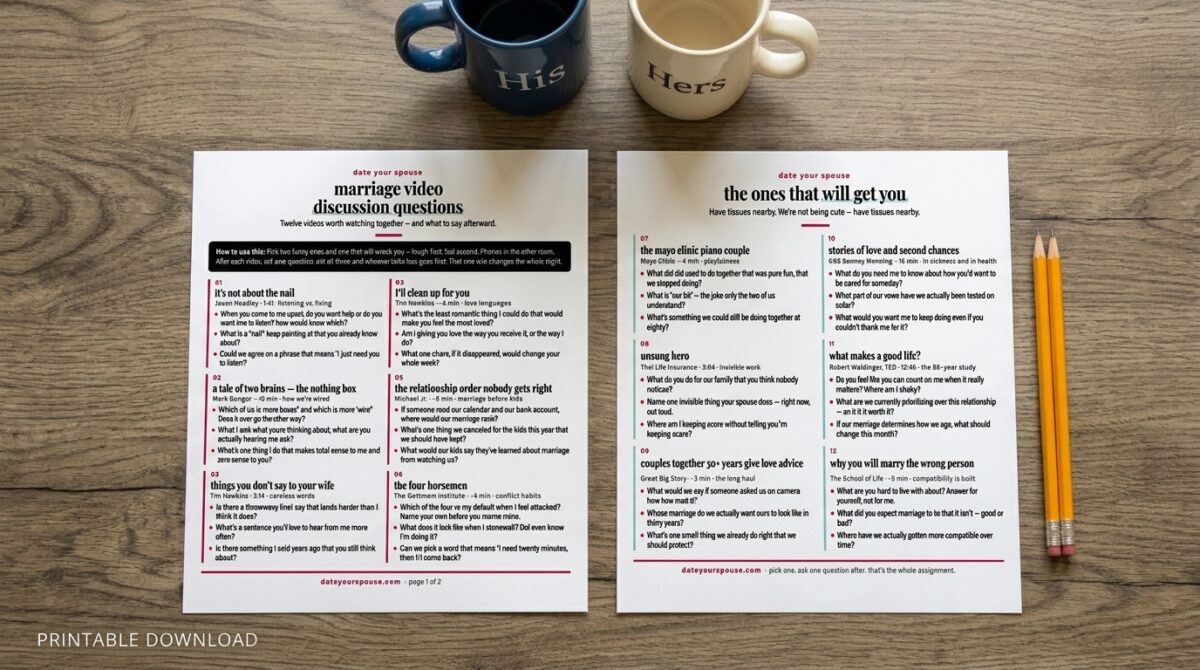
Free Printable: Discussion Questions for Every Video
We put all thirty-six questions on one sheet so you are not scrolling your phone in the middle of a moment. Print it for date night, or run copies for every table at your retreat.
Marriage Video FAQs
The most-used marriage videos are short clips that name one pattern and make you laugh before you can get defensive. The classics are It’s Not About the Nail by Jason Headley (listening versus fixing), Mark Gungor’s Tale of Two Brains (the nothing box), Tim Hawkins’ Things You Don’t Say to Your Wife (careless words), and Bruno Bozzetto’s wordless Women vs Men animation (how differently husbands and wives approach intimacy).
The nothing box is a bit from comedian Mark Gungor’s Tale of Two Brains routine. He describes a man’s brain as a set of separate boxes he opens one at a time, including one box with nothing in it that he can retreat into, while a woman’s brain is a ball of wire where everything connects. It is comedy, not neuroscience, but it explains a familiar exchange: what are you thinking about? Nothing.
The message is that being heard and being helped are two different needs. In the video, a woman describes a pain and her husband keeps pointing out the nail in her forehead instead of listening. He is factually right and relationally wrong. The lesson is to ask which one your spouse wants before you start solving.
Open with something funny to relax the room, put the emotional one in the middle rather than at the end, and never show more than three videos in one session. A reliable ninety-minute session: Things You Don’t Say to Your Wife, then It’s Not About the Nail, then the Mayo Clinic piano couple, then one commitment each written on a card. Have couples discuss at their own tables rather than sharing with the full group.
Pick two funny videos and one emotional one, put the phones in another room, and ask exactly one discussion question after each video instead of all three. Whoever talks less in your marriage answers first. The whole thing takes about twenty-five minutes, which leaves room for dessert.
Watch Something Together Tonight
You are going to watch something tonight regardless. That part is not in question.
The only question is whether you watch three hours of something that asks nothing of you, or two minutes of something that makes one of you say oh — that’s us.
Pick one. Ask one question after. That is the whole assignment.
And if he says he was thinking about nothing, he probably was.
More Marriage Resources
- The YouTube Scavenger Hunt Date — a fun date night full of laughs
- Roommate Syndrome in Marriage — 10 tiny hacks that get you back into lover mode
- The Weekly Marriage Meeting — twenty minutes that prevent most of the fights
- Date Ideas for Every Love Language — love them the way they actually feel it
- The Monthly Anniversary Tradition — the tiny ritual that lasted 66 years
- The Movie Night Snack Challenge — turn “let’s just watch Netflix” into a real date
- 35+ At-Home Date Night Ideas — for the nights nobody is leaving the house
Reader Favorites
Our most-loved bedroom games & date-night ideas for couples: