
It’s 9:14 on a Tuesday.
The dishwasher is running. One of you is scrolling. The other one is folding a laundry basket that has been sitting on the couch since Sunday. You’ve already covered the important stuff — who’s driving carpool, whether the car registration got renewed, what happened with your mom’s appointment.
And then you both go to bed. Not angry. Not distant, exactly. Just… done.
If you read that and felt a small pang, you’re not in a bad marriage. You’re in a very common one. There’s even a name for it now, and it’s showing up in more and more Google searches every month: roommate syndrome.
Here’s the good news, and we mean this: roommate syndrome is one of the most fixable things that happens to a marriage. It doesn’t require a weekend retreat, a therapist’s waiting list, or a personality transplant.
It requires small things, done on purpose, on repeat.
Below are ten of them. Most take under five minutes. A few take under ten seconds. All of them are things we’d bet you haven’t tried.
What Is Roommate Syndrome in Marriage?
Roommate syndrome is when a married couple quietly shifts from partners into co-managers. You still share a home, a calendar, a budget, and a very long to-do list — but the affection, playfulness, flirting, and curiosity that used to define you have thinned out almost to nothing. Conversation becomes logistics. Touch becomes functional. You’re an excellent team and a fading couple.
It is not a diagnosis. It is not infidelity. It is not a sign your marriage is failing.
It’s drift. And drift reverses the same way it happened: a little at a time.

7 Signs You’ve Slipped Into Roommate Syndrome
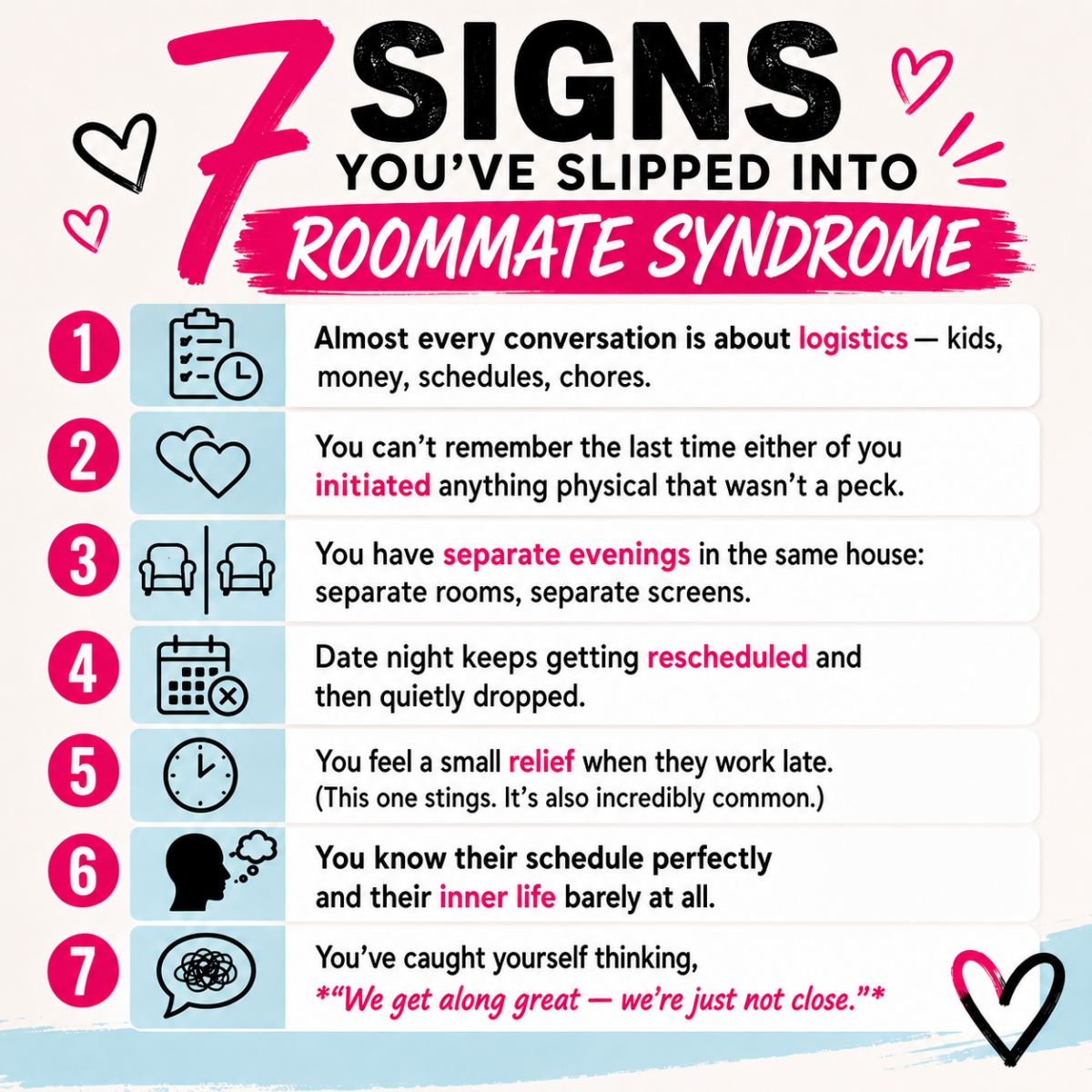
You don’t need all seven. Two or three is plenty of reason to try something new this week.
- Almost every conversation is about logistics — kids, money, schedules, chores.
- You can’t remember the last time either of you initiated anything physical that wasn’t a peck.
- You have separate evenings in the same house: separate rooms, separate screens.
- Date night keeps getting rescheduled and then quietly dropped.
- You feel a small relief when they work late. (This one stings. It’s also incredibly common.)
- You know their schedule perfectly and their inner life barely at all.
- You’ve caught yourself thinking, “We get along great — we’re just not close.”
Here’s the thing about that last one. Getting along great is not the opposite of roommate syndrome. Great roommates get along great. That’s the whole point.
Why Roommate Syndrome Happens (and Why It’s Not Your Fault)
Nobody chooses roommate mode. You get efficient at marriage.
When you have kids, jobs, aging parents, and a house that constantly needs something, your relationship becomes the one thing in your life with no external deadline. Nobody emails you when your marriage is behind. So the two of you get very, very good at handling the things that do have deadlines — and the connection quietly becomes the thing you’ll get to later.
Then one day you look up and “later” has been three years.
Marriage and intimacy coach Dan Purcell puts it well: the goal is getting out of roommate mode and into lover mode — a theme he unpacks in 10 Habits for a Sexy Marriage. And in his experience — and ours, across more than a decade of writing about this — that transition almost never starts with a big grand gesture. It starts with something small enough that you’ll actually do it tomorrow.
So let’s get practical.
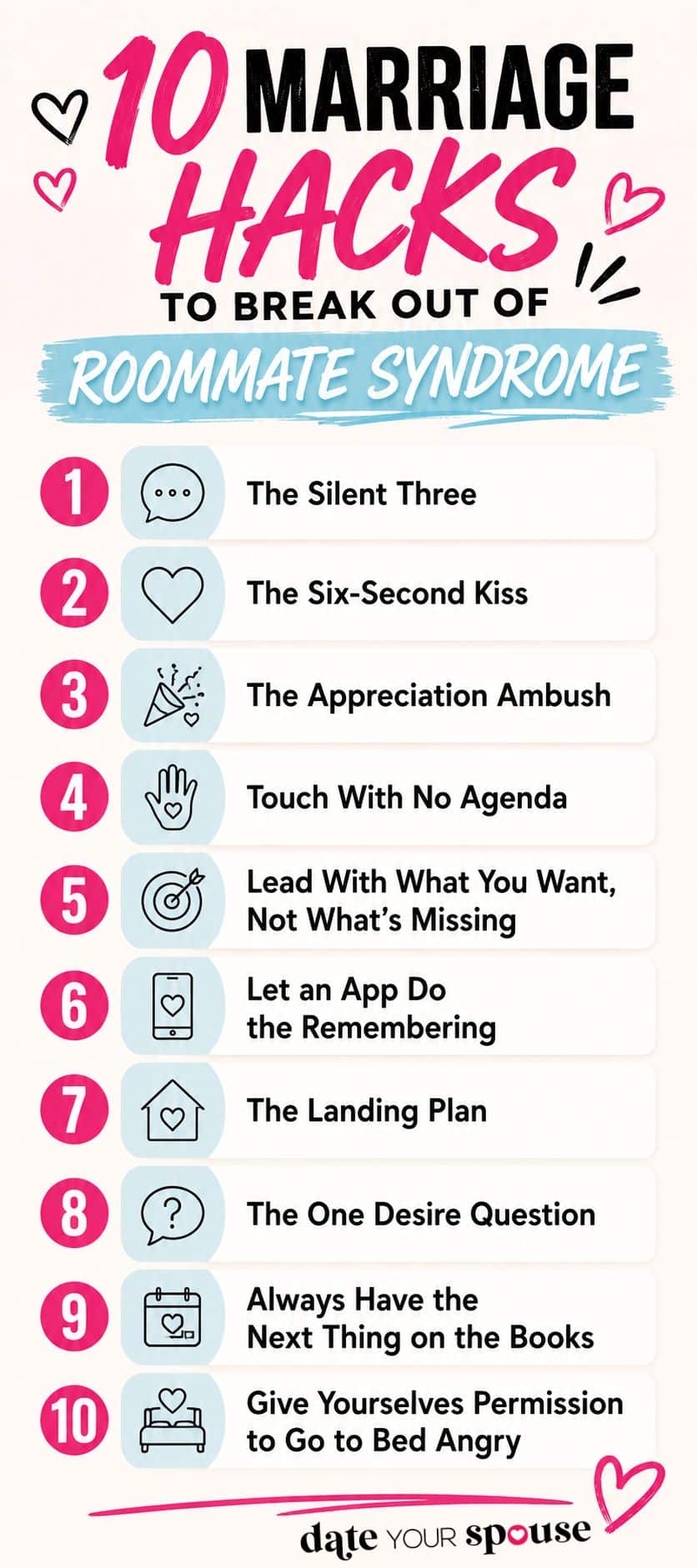
10 Marriage Hacks to Break Out of Roommate Syndrome
1. The Silent Three
Time: 3 minutes. Difficulty: surprisingly hard.
Set a timer for three minutes. One person talks about anything — their day, a worry, a thought they haven’t said out loud. The other person says absolutely nothing. No advice. No fixing. No “well, have you tried—”. Just eye contact and silence.
When the timer goes off, switch.
That’s the whole hack. And it is one of the most quietly powerful things a couple can do, because most of us aren’t actually listening when our spouse talks — we’re loading our response. Removing the option to respond forces something rare: actual hearing.
Dan Purcell has coached couples who tried this for a couple of weeks and said it moved their communication further than years of talking in circles. One husband admitted he wanted to interrupt about twenty times in the first three minutes. When he finally made it through, his wife said something she’d never said before: “I finally feel heard. Not listened to. Heard.” If you want the deeper version of why that lands so hard, his episode on two types of intimacy you’ve never heard about is worth the drive to work.
Do it tonight: phones in another room, timer on, three minutes each. That’s six minutes total.
2. The Six-Second Kiss
Time: six seconds. Difficulty: mild awkwardness on day one.
Count it out. Most married couples kiss goodbye for well under a second — it’s a formality, not a kiss. Dr. John Gottman’s research popularized the six-second version, and the reason it works is almost silly: six seconds is long enough that you have to actually be present for it.
You cannot check your phone during a six-second kiss. You cannot mentally draft an email. For six seconds a day, your nervous system gets a clear message: this person is still my person. It’s the same principle behind the Gottman Institute’s “small things often” research — tiny, frequent moments of connection predict lasting happiness far better than occasional grand ones.
Do it every morning before you split up for the day, and again when you reunite. Two windows a day, twelve seconds total. That’s it.
3. The Appreciation Ambush
Time: 30 seconds. Difficulty: requires you to notice things.
Before you fall asleep, tell your spouse one specific thing you noticed them do today that you appreciated.
Specificity is the entire hack. “You’re a great husband” slides right off. “I noticed you took the trash out before I could ask, and I didn’t say anything at the time, but it made my whole morning easier” lands. Generic praise says I’m being nice. Specific praise says I see you.
Try it for fourteen nights straight. Two things happen. Your spouse starts feeling noticed — and you start scanning your day for things to appreciate instead of things to resent. That second one might be the bigger win.
If you want the long-game version of this, we love the monthly anniversary tradition that kept one woman feeling cherished for 66 years.
4. Touch With No Agenda
Time: 10 seconds. Difficulty: honest self-examination required.
This one is uncomfortable and it’s the reason a lot of couples are stuck.
In a lot of marriages, touch has become transactional. A hand on the back, a shoulder rub, a hug from behind while they’re at the sink — and both people know it’s a bid for something else. Which means the receiving spouse learns to brace. And once touch means a negotiation is starting, it stops being affection at all.
So here’s the hack: touch your spouse today in a way that clearly cannot lead anywhere. Squeeze their hand walking to the car. Kiss the top of their head while they’re on a work call. Rest a hand on their shoulder for three seconds while they’re cooking, then walk away and go do something else.
Walking away is the important part. You’re rebuilding a signal that got scrambled: I touch you because you’re mine, not because I want something.
Do this for two weeks and watch what happens to how they respond to touch generally.
5. Lead With What You Want, Not What’s Missing
Time: one sentence. Difficulty: hardest one on this list.
When you finally bring up the distance, most of us open with the absence: “You never touch me anymore.” “We never do anything fun.” Both are true. Both also land as an accusation, and your spouse’s defenses go up before you’ve finished the sentence.
Relationship coach Dr. Chavonne Perotte teaches a small reversal that changes everything: lead with the want, not the lack. (She breaks it down beautifully in the episode Are We Roommates or Lovers?)
- Instead of “We never do anything anymore” → “I’d love for us to have something fun on the calendar. Want to pick something together?”
- Instead of “You never touch me” → “I miss being playful with you. Can we bring some of that back?”
- Instead of “We’re basically roommates” → “We’re crushing the logistics of our life. I want us back too.”
Same content. Completely different conversation. One puts your spouse on trial; the other puts them on your team.
6. Let an App Do the Remembering
Time: 2 minutes a day. Difficulty: zero.
Here’s an uncomfortable truth about every hack on this list: the problem is almost never motivation. It’s memory. You want to connect. At 9pm you’re just too fried to think of how.
That’s exactly the gap our Spark’d app was built to fill — it was designed specifically to help couples beat roommate syndrome by turning connection into a daily habit instead of a good intention. It hands you a question, a quiz, or a game every day so neither of you has to invent one. It has an AI Romance Concierge that will plan a date night for you from thousands of ideas when your brain is empty. It keeps a private calendar of your favorite moments together. And it has at-home date night games in both romantic and adventurous editions for the nights you can’t go anywhere.
We’re biased, obviously — we made it. But we made it because we kept watching couples know exactly what to do and still not do it. Take the deciding off your plate and the doing gets a whole lot easier.

7. The Landing Plan
Time: 30 seconds of planning. Difficulty: easy, and almost nobody does it.
Here’s a scenario every parent knows. You go out. You laugh. You flirt a little. You remember why you liked each other. Then you walk in the door and — babysitter, backpacks, someone’s still awake, dishes in the sink — and by the time the house is quiet, the entire evening has evaporated.
This is Dan Purcell’s fix, and it’s brilliant in its simplicity: before you leave, decide what happens when you get home.
Who pays the sitter. Who does the last check on the kids. What you’re not going to do (the dishes can wait). And what you are going to do — sit on the porch for ten minutes, put on a record, go straight to your room.
Momentum is the whole value of a date night, and momentum is fragile. Protect the landing.
8. The One Desire Question
Time: 60 seconds a week. Difficulty: requires an honest answer.
Once a week, each of you answers one question:
“What’s one thing I could do this week that would make you feel really loved?”
Then you actually go do it.
Most of us guess at what our spouse needs, and most of us guess wrong — because we give what we would want. This deletes the guessing. It also gives both people a socially safe way to ask for something without it landing as a complaint.
One rule: answer honestly, not politely. “Nothing, you’re fine” is not an answer. If the real answer is “I want you to plan something so I don’t have to,” say that.
If you want a head start on what your spouse is likely to say, our date ideas for every love language is a good cheat sheet.
9. Always Have the Next Thing on the Books
Time: 5 minutes, once. Difficulty: easy.
Couples who beat roommate syndrome almost all share one habit: there is always something on the calendar. Not a vacation. Just a next thing.
A countdown does something to a marriage that nothing else quite does — it gives you a shared future to point at when the present is nothing but carpool. And it also solves the “so what do you want to do?” stalemate that kills more date nights than budget ever has.
This is why we feel so strongly about making date night a priority- it’s something to look forward to all week!

When you’re planning, put play on the agenda deliberately. Pick a date, pick who’s planning it, pick who handles the sitter. If you want zero decision fatigue, alphabet dating gives you a built-in order — you just do the next letter.
Or grab one of these tonight, no planning required:
- The Movie Night Snack Challenge — turns “let’s just watch Netflix” into an actual date
- The Paper Tablecloth Date Night — the pizza you were already ordering, upgraded
- The Target Face Match Date — free, and you will laugh harder than you have in months
- At-Home Pizookie Date Night — 20 minutes and one skillet
- Couple’s Pictionary — your memories, badly drawn
- The Drawing Date Night — free, hilarious, and secretly a communication exercise
And if even that feels like too much this week, start with the smallest version of all: the marriage hack that turned doing dishes into our favorite mini date night. No sitter, no planning, no leaving the kitchen.
10. Give Yourselves Permission to Go to Bed Angry
Time: however long you need. Difficulty: it’ll feel wrong.
“Never go to bed angry” is quite possibly the most repeated piece of marriage advice on earth, and therapist Kendra Nielsen calls it what it is: bad advice for a lot of couples. (She and Dan take apart three of these classics in Three Cringe-worthy Pieces of Marriage Advice.)
Here’s why. Spouses process at wildly different speeds. One of you might sort out a feeling in eleven minutes. The other might need a full day to even figure out why it stung. Forcing a resolution at 11:45pm doesn’t produce peace — it produces a fast processor steamrolling a slow one, and a slow processor agreeing to something just to get to sleep. That’s not repair. That’s resentment on layaway.
The better rule: never go to bed disconnected. You can absolutely say, “I’m not done with this, and I still love you. Can we pick it up tomorrow after work?” Then touch them. Then sleep.
Unresolved is fine. Unattached is not.
How Long Does It Take to Get Out of Roommate Syndrome?
Most couples feel a noticeable shift within two to three weeks of doing one small thing daily — usually in warmth and ease long before anything dramatic changes. That timeline surprises people, because roommate syndrome takes years to build and feels permanent when you’re in it.
But it isn’t built out of one big broken thing. It’s built out of a thousand tiny absences. Which means it comes apart the same way it went together: one small presence at a time.
Pick one hack from this list. Not ten. One. Do it for fourteen days before you add a second.
Roommate Syndrome FAQs
Is roommate syndrome a sign my marriage is ending?
No. In the vast majority of cases it’s a sign you’re busy, not a sign you’re incompatible. Roommate syndrome is a drift pattern, and drift responds to attention faster than almost any other marriage problem.
What if my spouse doesn’t want to work on it?
Start alone. Nearly every hack on this list — the six-second kiss, the appreciation ambush, touch with no agenda, leading with what you want — works even if only one of you is doing it on purpose. Marriages are systems. Change one side and the other side moves. Just give it a few weeks before you evaluate.
We’re not fighting at all. Can we still have roommate syndrome?
Yes, and this is the version that sneaks up on people. Roommate syndrome usually shows up as pleasant. No conflict, no heat, no friction — and no spark either. Peace and closeness are not the same thing.
Does roommate syndrome happen after the kids leave too?
It can hit hardest then, because the shared project that organized your whole life just walked out the door. We wrote a whole guide on keeping the spark alive for empty nest couples if that’s your season.
What’s the single fastest thing we can do tonight?
The six-second kiss, and then three minutes of silent listening each. Total time: about six and a half minutes. Do it tonight and you’ll have already broken the pattern.
You’re Not Broken. You’re Just Overdue.
Roommate syndrome is what happens when two people who love each other get really good at running a life together and forget to keep choosing each other inside it.
It isn’t a verdict. It’s a nudge.
So tonight — not next month, not when things calm down, because things are not going to calm down — pick one thing off this list. Kiss them for six full seconds. Tell them the one specific thing you noticed. Set a three-minute timer and just listen.
Small things, done on purpose, on repeat. That’s the whole secret, and it always has been. It’s exactly why you should never stop dating your spouse.
You already live with your favorite person. Let’s go get them back.
Reader Favorites
Our most-loved bedroom games & date-night ideas for couples: