It’s Sunday night.
The week ahead is already stacked up in front of you like a pile of laundry. Somebody has a dentist appointment. Somebody needs cleats. There’s a thing on Thursday you keep forgetting about. You’ll figure it out in the family group chat tomorrow, probably.
And the two of you, the actual couple at the center of all this, will get about nine minutes of each other’s undivided attention between now and next Sunday. Most of it while brushing your teeth.
That’s not a marriage problem. That’s a logistics problem that eventually becomes a marriage problem.
So here’s the fix, and it is almost too simple. It’s called the 5-5-5 rule, it takes fifteen minutes, and you do it once a week.
That’s it. Fifteen minutes. One night a week. We’ve watched this one small habit do more for couples than an entire marriage book- not because it’s clever, but because it’s small enough that you’ll actually do it.

What Is the 5-5-5 Rule in Marriage?
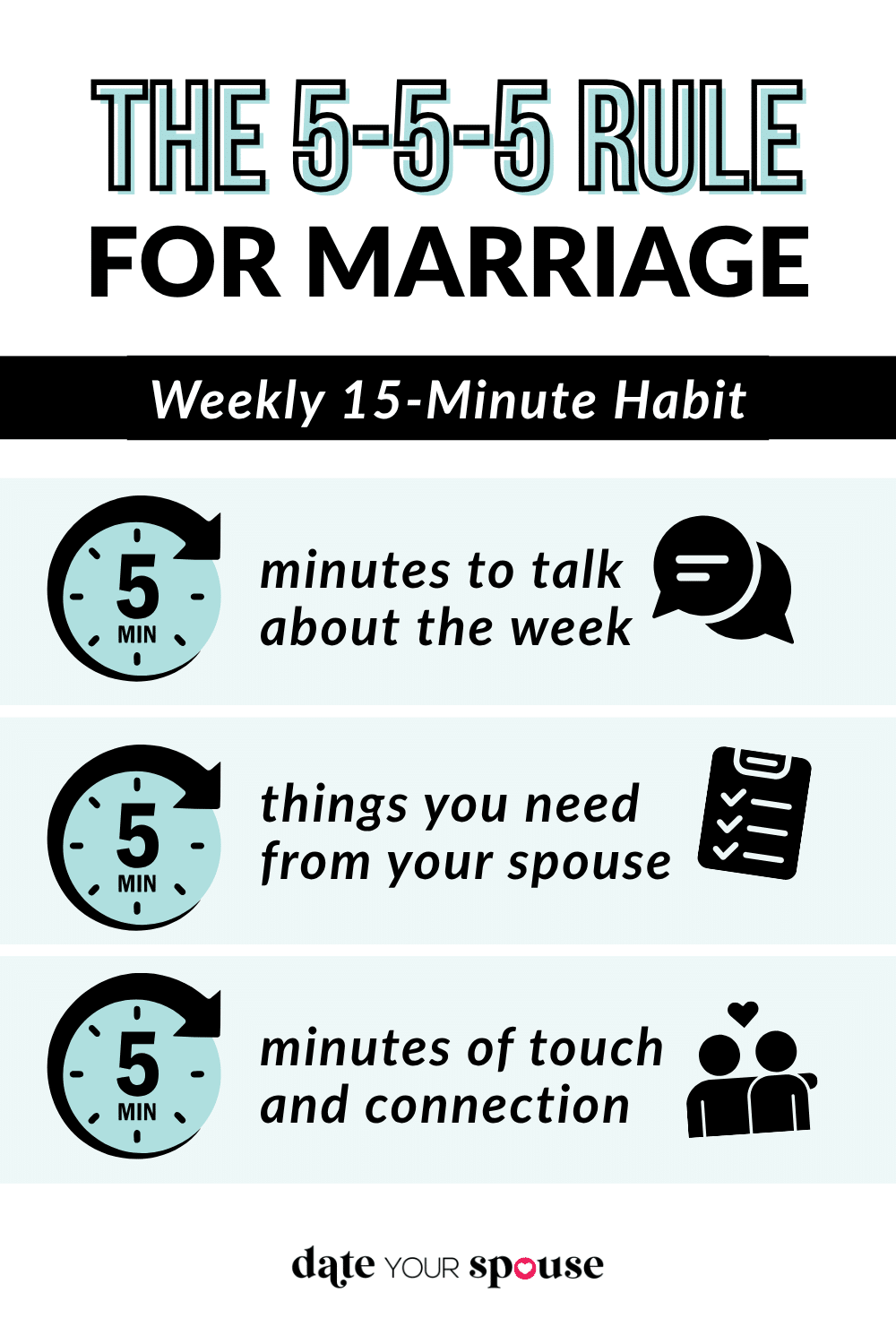
The 5-5-5 rule is a weekly, fifteen-minute marriage routine made of three five-minute parts:
- 5 minutes to talk about the week together — what’s coming, what’s heavy, what you’re looking forward to.
- 5 things you need from your spouse this week, said out loud — actually spoken, not hinted at.
- 5 minutes of physical connection with no agenda — touch that isn’t going anywhere and isn’t asking for anything.
Sunday evening is the natural home for it, because you’re standing at the front edge of the week instead of the wreckage of it. But the day matters far less than the repeat. Tuesday-night couples do just as well as Sunday-night couples. Couples who “do it when we get a chance” do not.
Why Fifteen Minutes Actually Works
Fifteen minutes sounds too small to matter. That’s exactly why it works.
Most marriage advice fails at the same spot: not motivation, but capacity. You already want to connect with your spouse. At 9pm on a Sunday you just don’t have a weekend retreat, a therapist’s opening, or the emotional bandwidth for a two-hour State of the Union. So the connection becomes a thing you’ll get to later, and later quietly becomes three years.
The Gottman Institute has a phrase for the antidote: small things often. Their decades of research keep landing on the same unglamorous conclusion- tiny, frequent moments of turning toward each other predict lasting happiness far better than occasional grand gestures do. A surprise trip to Cabo is wonderful. But it is not what keeps you close in March.
The 5-5-5 rule is “small things often”, put on a calendar.
And notice what it covers:
- One block for your logistics
- One block for your needs
- One block for your bodies
Those are the three places marriages drift apart, and most couples are only maintaining the first one. If that sounds familiar, you may be further into roommate syndrome than you realized, and this routine is one of the cleanest ways out of it.
The First 5: Five Minutes to Talk About the Week Together
Time: 5 minutes. Difficulty: easy — as long as you don’t let it become a big scheduling meeting.
Sit down together. Set a timer for five minutes and talk about the week ahead.
Here’s the trap, and nearly every couple falls into it the first time: this turns into a giant calendar review. Carpool, soccer, the dentist, who’s picking up the prescription. If the entire discussion is pure administration, you will both walk away feeling like you just had a staff meeting with someone you’re married to.
Logistics are necessary, but connection is the main point.
So anchor the conversation with three questions instead:
- What’s the hardest thing on your plate this week? (What feels heavy?)
- What are you actually looking forward to? (If nothing, what can we add that would be fun or rewarding?)
- Where do you most need me to have your back? (What should I be aware of?)
Those three questions get you somewhere a shared Google Calendar never will. You stop tracking your spouse’s schedule and start tracking their actual week– the pressure of it, the dread of it, the one good thing they’re holding onto.
One rule while your spouse is answering: don’t fix anything. Don’t problem-solve, don’t optimize their Thursday, don’t suggest they just wake up earlier. Just listen and say something like “that sounds like a lot.” Most of us aren’t really listening when our spouse talks, we’re loading our response. And our spouses can always tell. If that’s a habit worth breaking, our guide to active listening is worth five minutes of your week.
If this feels awkward at first, that’s normal. It usually starts to feel more natural by week three.
The Second 5: Five Things You Need From Your Spouse, Said Out Loud
Time: 5 minutes. Difficulty: the hardest of the three, by a mile.
Each of you names five things you need this week. Out loud. Specific. To their face.
This is where couples squirm, and the reason is worth sitting with. Most of us were quietly taught that a good spouse shouldn’t have to ask- that if they really loved you, they’d notice. So instead of asking, we hint. We sigh at the dishes. We mention offhand that so-and-so’s husband planned a whole date night. We wait to be read like a book, and then feel unloved when we’re not.
Hinting is not communication. It’s a test your spouse doesn’t know they’re taking.
Say the thing.
And say it as a request, not a review of their performance:
- Instead of “you never help with bedtime” → “I need you to take bedtime on Wednesday so I can breathe.”
- Instead of “we never talk anymore” → “I need twenty minutes with you after the kids are down on Tuesday.”
- Instead of “you’re always on your phone” → “I need your eyes when I’m telling you about my day.”
- Instead of “you don’t find me attractive anymore” → “I need you to flirt with me this week. Actually flirt.”
Same topic. Completely different conversation. One puts your spouse on the defensive; the other puts them on your team. (And if most of your needs sound like “please take something off my plate,” you may be carrying a lopsided mental load. Here’s how to share it.)
Three ground rules make this block safe enough to keep doing:
- Keep them small. Five needs for one week means five doable things, not five huge overhauls. “Text me at lunch” is a perfect entry.
- No defending. The listener’s only job is to hear it and say “got it.” Not “well, I would have, but—”. You can discuss it later in the week if you need to.
- No scorekeeping. If your spouse only gets to three of their five, they’re not failing. This is a habit, not a performance review.
One more thing worth watching for: sometimes this block surfaces friction. That’s not the routine failing- that’s the routine working. A need you can say out loud is a need your spouse can actually meet. A need you swallow just turns into resentment with a longer fuse.
The couples who worry us aren’t the ones who disagree. They’re the ones who have quietly stopped bringing up anything that might turn into a fight. That feels like peace for a while, and then one day you look up and realize the only safe topic left is the calendar. Your marriage cannot get better at something neither of you is willing to be honest about. So if this block gets uncomfortable, read it as proof you’ve built enough safety to be honest with each other. Here’s why conflict in marriage isn’t the enemy and what healthy disagreement actually looks like.
The Third 5: Five Minutes of Physical Connection With No Agenda
Time: 5 minutes. Difficulty: requires some honest self-examination.
Five minutes of touch that is not going anywhere.
Hold each other on the couch. Sit with their head in your lap. Slow dance in the kitchen to one song. Hold hands and say nothing at all. The specific activity matters far less than the thing you’re proving: I want to be close to you for its own sake.
Here’s why this block matters more than it looks. In a lot of marriages, touch has quietly become transactional. A hand on the back, a shoulder rub, a hug from behind at the sink- and both people know it’s a bid for something else. So the receiving spouse learns to brace. And once touch reliably means a negotiation is starting, it stops functioning as affection at all.
Which is why the trap to watch for is offering non-sexual touch as a strategy. If the thinking underneath it is if I do more of this, I’ll get more of that, it won’t work- and it often makes things worse, because your spouse can feel the agenda underneath your hand. Touch given to earn something isn’t a gift. It’s an invoice.
Here’s a trick that makes this block startlingly effective, and you can test it in about ten seconds. While you’re touching your spouse, deliberately think about what you adore about them– something you admire, something you find attractive, something you’re grateful for. The physical touch is identical. What it communicates is not. Your spouse can absolutely feel the difference between an arm around the shoulder and an arm around the shoulder that means I’m so glad you’re mine.
The no-agenda rule is the whole point of this block, so protect it. If these five minutes always turn into expected sex, one of you may start dreading them- and you’ll have accidentally rebuilt the exact transaction you were trying to undo. If things go somewhere on their own some weeks, wonderful. But the five minutes have to be able to end at five minutes.
What you’re rebuilding is a signal that got scrambled somewhere along the way: I touch you because you’re mine, not because I want something.

How to Start the 5-5-5 Rule This Sunday
Don’t announce a whole new marriage initiative. Try this instead:
- Pick your fifteen minutes. Sunday after the kids go down is the classic. Put it in your phone as a repeating event so neither of you has to remember it.
- Ask small. “Can I steal fifteen minutes with you Sunday? I read about something I want to try.” That’s the entire pitch.
- Set an actual timer. It sounds clinical. But it’s really the opposite- a timer means neither of you is wondering how long this is supposed to go, which is what makes it feel safe to be honest.
- Do all three blocks in order. The order isn’t accidental. Talking earns the honesty; honesty earns the closeness. Skipping to block three when you haven’t done blocks one and two is why so many couples feel distant.
- Commit to four weeks before you judge it. Week one is awkward. Week two is better. Somewhere around week three, most couples stop needing the timer.
And if the whole thing falls apart one week? Start again the next Sunday. The couples who win at this aren’t the ones who never miss. They’re the ones who stay consistent.
What If My Spouse Thinks It’s Cheesy?
Lead with the fifteen minutes, not the whole 3-part framework. Nobody resists fifteen minutes. What people resist is the implication that something is wrong.
So don’t open with “we have a communication problem.” Open with “I love you and I miss you. Fifteen minutes on Sunday?” You can call it the 5-5-5 rule later, once it’s already working and they’re the one reminding you about it.
What If We Keep Forgetting?
Then the problem isn’t your marriage- it’s your memory, and that’s an easier thing to fix. Set a recurring Sunday alarm labeled something you’ll actually smile at. Attach it to something you already do every week without fail.
This is the same gap our Spark’d app was built to fill- it hands you a question or a game every day so neither of you has to invent one when your brain is empty at the end of the day. Take the deciding off your plate and the doing gets a whole lot easier.
The 5-5-5 Rule: FAQs
No. Sunday works well because you’re at the front edge of the week rather than the end of it, so the needs you name still have time to happen. But any consistent night beats an inconsistent Sunday. Pick the night you’re least likely to cancel.
Name two or three then. Five is a target, not a quota. And if you can barely get to three the first week- that itself is useful information the routine gives you. The number climbs naturally once asking stops feeling risky or dangerous.
It’s not enough to be your whole marriage- it’s not a replacement for date night, and it won’t resolve a serious ongoing conflict. What fifteen consistent minutes does is stop the drift. Most couples don’t lose each other in a blowup; they lose each other in a thousand tiny absences. The 5-5-5 rule puts a floor under that.
Run your half anyway. Ask them the three questions in the car. Say your needs out loud without requiring them to say theirs. Touch them with no agenda. Marriages are systems- change one side and the other side moves. Give it a few weeks before you evaluate.
Yes, with one swap. Blocks one and two work fine over a video call. For block three, substitute five minutes of undivided attention with no agenda- camera on, no multitasking, no logistics. Not the same as touch, but it protects the same principle.
Most weekly check-ins are really family business meetings- calendar, money, kids. Useful, but they treat your marriage like a company you co-own. The 5-5-5 rule deliberately adds the two things a business meeting never covers: what you personally need, and physical closeness. That’s the difference between running your life well and staying in love while you do it.
Try the 5-5-5 Rule This Sunday
Fifteen minutes. Five to talk, five to ask, five to just be close.
Nobody is going to email you when your marriage is behind. There’s no deadline, no alert, no manager checking in on the two of you. That’s precisely why the relationship is the thing that quietly slides while everything with a due date gets handled.
So give it a deadline. Sunday, fifteen minutes, on the calendar, on repeat.
Small things, done on purpose, on repeat. That’s the whole secret — and it’s exactly why you should never stop dating your spouse.
You already live with your favorite person. Give them fifteen minutes this Sunday.
Reader Favorites
Our most-loved bedroom games & date-night ideas for couples: